
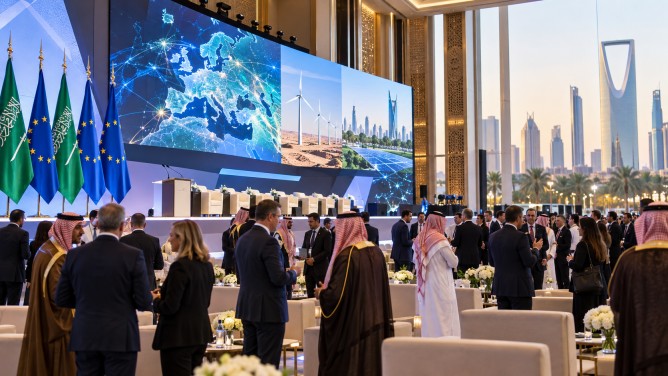
The EU-Gulf Cooperation Council (GCC) Summit, set to take place on October 24 in Riyadh, will focus on fostering investment in artificial intelligence, digital infrastructure, clean energy, and advanced industries. This summit aims to strengthen the economic and political ties between the European Union and GCC states, expanding their partnership beyond traditional trade.
Trade between the EU and GCC countries reached €165.7 billion in 2025. However, both regions are now looking to deepen their collaboration through investment and long-term joint projects. Artificial intelligence is emerging as a pivotal area for potential cooperation. Discussions at the summit may cover investments in data centers, cloud computing, AI applications, and cybersecurity, leveraging the Gulf’s investment potential and Europe’s expertise in research and technology.
Digital connectivity is another key focus, with plans to extend cooperation beyond traditional transport and trade links. This could include telecommunications networks, data centers, cloud services, and cross-border data infrastructure. Clean energy also remains a priority, with potential collaboration in solar and wind power, green hydrogen, energy storage, and smart grids, aligning with European demand for large-scale energy investments.
The summit’s agenda may also explore opportunities in advanced manufacturing, logistics, fintech, healthcare technology, and industrial equipment, fostering integrated value chains spanning both regions. The ongoing EU-GCC free trade agreement negotiations are crucial, as the EU seeks improved market access and clearer trade and investment rules. Consultations with businesses and investors are part of assessing the agreement’s economic impact.
For Saudi Arabia, this broader partnership aligns with the Vision 2030 objectives, focusing on economic diversification, attracting investment, and developing non-oil industries. Both Saudi Arabia and the EU support the India-Middle East-Europe Economic Corridor, which could further enhance cooperation in transport, energy, and digital infrastructure.
A business forum planned alongside the summit is expected to facilitate discussions on potential projects in AI, data centers, clean energy, and other sectors. While specific joint AI or technology investment projects have not been formally announced, the summit aims to transform broader economic priorities into practical partnerships and investment opportunities.
